
Quality of Life Assessment Tools for Veterinary Practices: Paper Forms vs. Digital

Most veterinary practices already use a quality of life scale in some form. Often it’s a printed HHHHHMM sheet handed to a family at a recheck, or a PDF emailed after a hard conversation. It’s a good habit. Structured questions help families describe what they’re seeing at home, and they give your team something more concrete to work with than “she’s just not herself.”
But a scale is only as useful as the answers you get back. This guide covers what a quality of life assessment tool should do for your practice, where paper forms tend to fall short, and what to look for if you’re considering a digital option.
What a Good Assessment Tool Does for Your Practice
1. It’s completed by the people who see the pet every day
Families are the best observers of how a pet is living at home, and most quality of life tools are designed for owners to complete. In a 2015 review of quality of life instruments for dogs, every one of the validated instruments was completed by owners. A tool that families fill in at home, where the pet behaves normally, will usually tell you more than one scored in the exam room.

2. It covers the areas that matter, including the caregiver
The 2016 AAHA/IAAHPC End-of-Life Care Guidelines list pain, difficulty eating and drinking, breathing, elimination problems, mobility, mood and engagement with surroundings among the needs to assess at the start of an end-of-life plan. A useful tool should ask about most of these.
The guidelines also ask practitioners to discuss the client’s ability and willingness to provide the extra care a terminal patient needs. That matters: in a 2017 study of 238 dog and cat owners, those caring for a pet with a chronic or terminal illness reported more stress, more symptoms of depression and anxiety, and poorer quality of life than owners of healthy pets. A tool that asks how the household is coping gives you an opening to talk about it.
3. It’s easy to repeat
A single score is a snapshot. Trends are what show you and the family whether a plan is working. The AAHA/IAAHPC guidelines recommend that every end-of-life treatment plan include a schedule for follow-up communication and reassessment, so the tool should be easy to complete again next week or next month and compare.
4. It ends up in the medical record
The same guidelines recommend recording the treatment goals a client describes, as specifically as possible, in the patient’s medical record. Assessment results belong there too, ideally without anyone retyping them.
A note on validation: most quality of life scales in everyday use are structured guides rather than validated instruments. The 2015 review found 52 published quality of life instruments for dogs, and only 11 had evidence of validation. That doesn’t make everyday scales less useful. Treat them as a consistent way to gather observations and track change over time, alongside your own exam, rather than as a diagnostic cutoff.
Common Options, Compared
| Option | Works well for | Where it falls short |
|---|---|---|
| Printed scale in the exam room | A quick, familiar structure during a consult | Scored once, often under stress and away from home; hard to compare over time; has to be scanned or retyped |
| Take-home paper or PDF form | Letting the family score at home, where the pet behaves normally | Often doesn’t come back, or comes back as a phone photo; totaled by hand; no history |
| Validated questionnaire for one condition | Measuring a single problem, such as chronic pain, consistently | Narrow by design, while many senior and hospice patients have more than one condition |
| Digital assessment tool | Sending before a visit, scoring automatically and keeping a history | The family still has to complete it, so it may need a gentle reminder |
Where Paper Forms Fall Short
- They’re often scored at the hardest moment. A family completing a scale in the exam room, sometimes right after difficult news, is scoring through stress and in an unfamiliar setting.
- They’re rarely repeated. Paper forms don’t usually get completed on a schedule, so you see a single point rather than a trend.
- They don’t always come back. Take-home forms are easy to misplace before the next appointment.
- They create admin work. Someone has to total the scores, scan the page and attach it to the record.
- The conversation stops at the door. Once the form is handed back, you often don’t hear how the pet is doing until the next visit or phone call.
What to Look for in a Digital Tool
- No app or account needed for the family to complete it
- Covers the main quality of life areas, plus how the household is coping
- Scores each category, not just a single total
- Sends the results to your practice, with a PDF you can attach to the record
- Keeps a history so you can compare assessments over time
- Lets the family decide what they share, and stop sharing whenever they choose
- Works with your practice management software, or at least doesn’t create double entry
- Free, or low-cost, for your practice to try
How Hospet’s One-Time Assessments Work
Hospet is a free quality of life tracking app for pet families, and Hospet Connect is its free account for veterinary teams and other care providers. With one-time assessments, you can send any client a quality of life assessment, whether or not they use Hospet.
- In Hospet Connect, enter your client’s name and email. Add the pet’s details or a personal note if you like.
- Your client gets an email with a link and completes the full assessment in their browser in about 10 minutes, without downloading an app or creating an account.
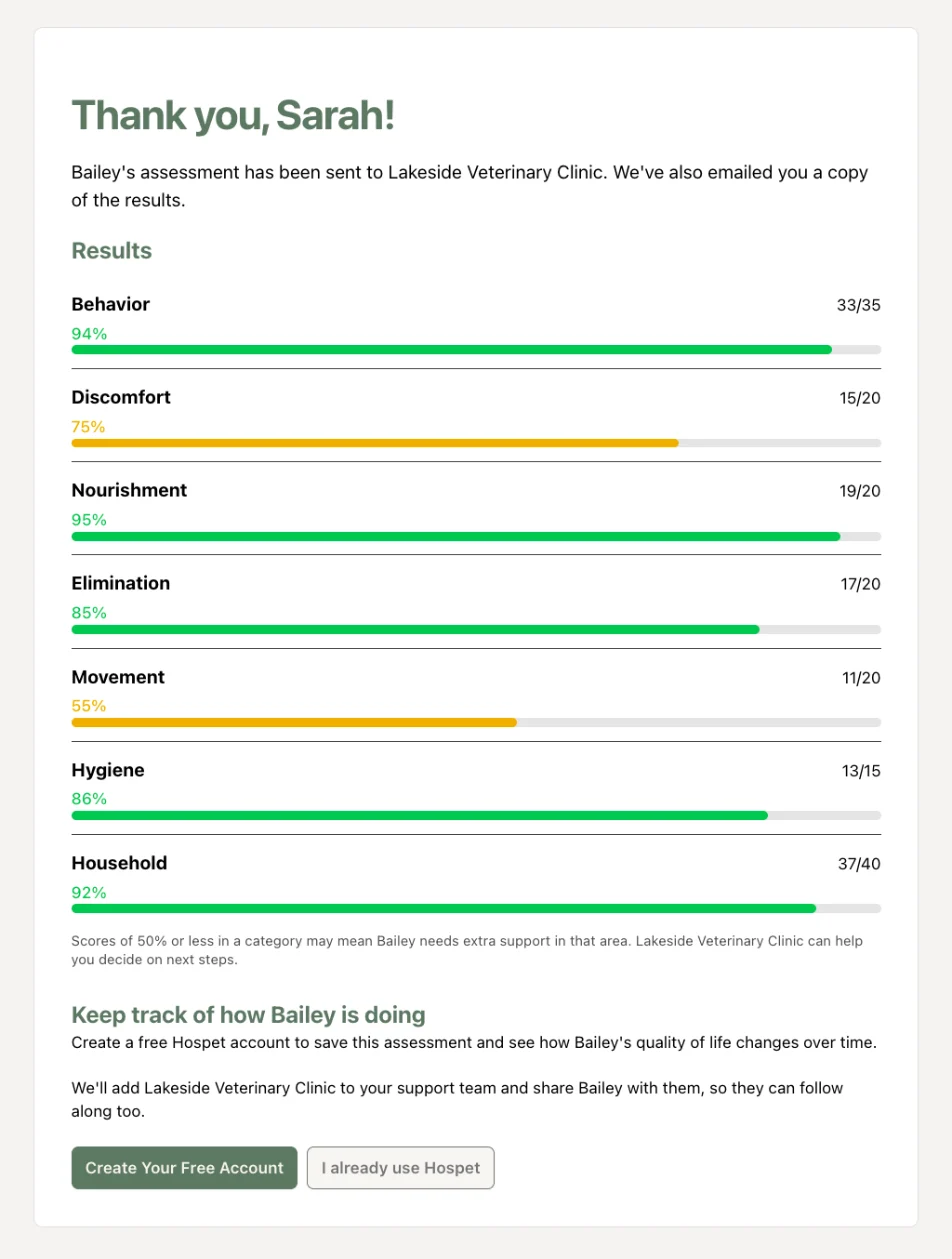
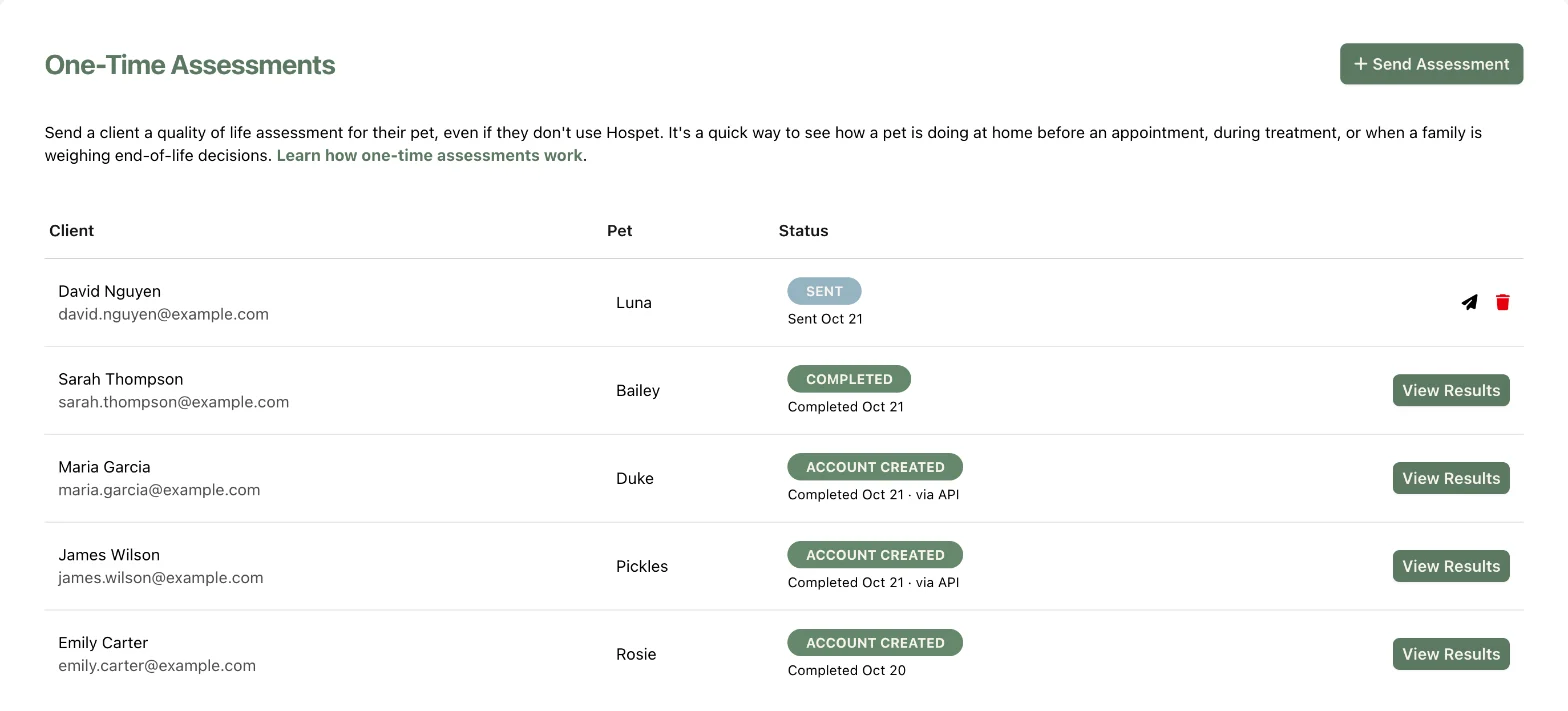
- When they submit it, you get an email with each category’s score and the full assessment attached as a PDF. Your client gets a copy too, and every assessment is listed in Hospet Connect.
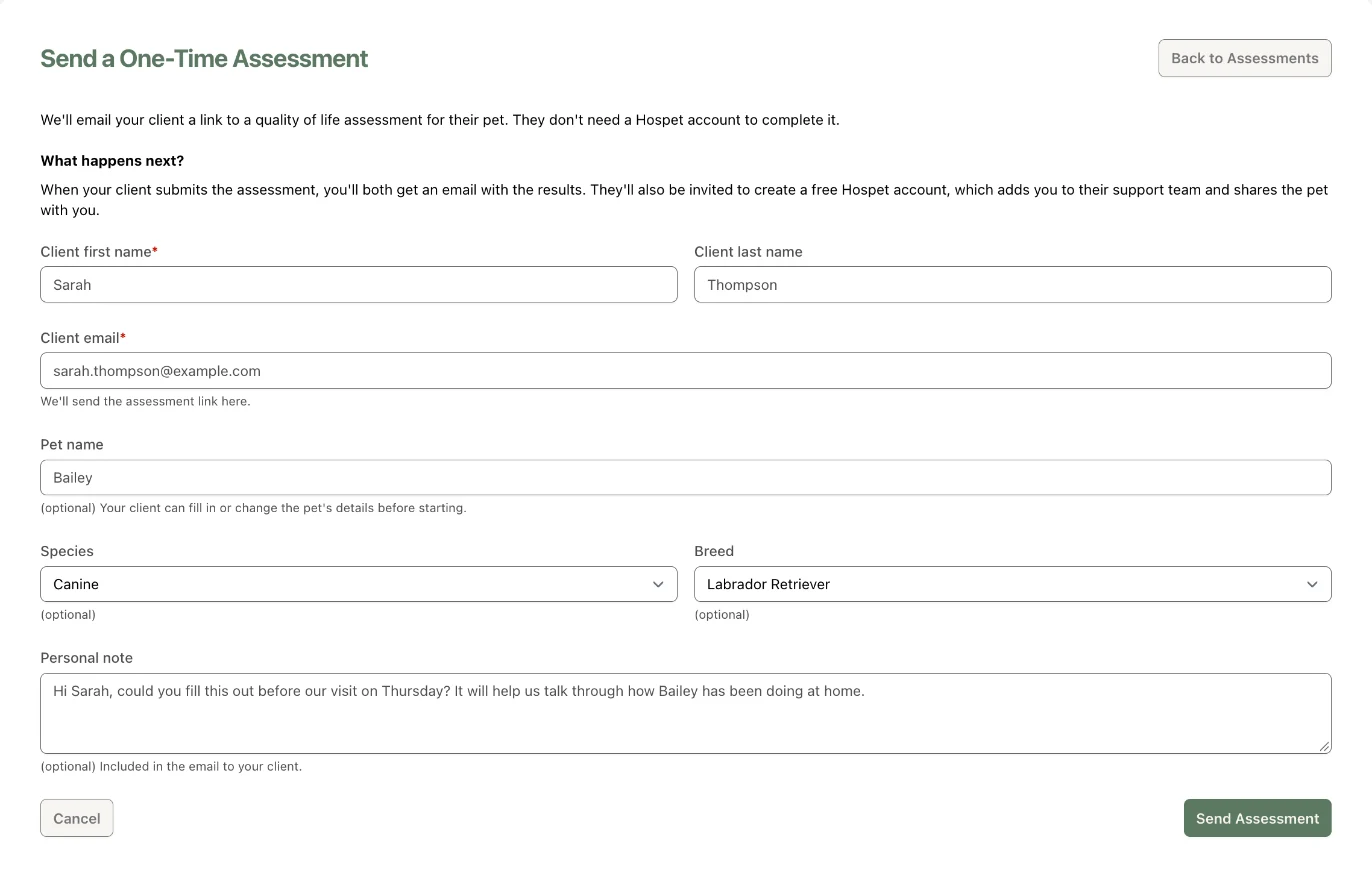
The assessment covers seven areas: Behavior, Discomfort, Nourishment, Elimination, Movement, Hygiene and Household, which asks how caring for the pet is affecting the family. Each statement is answered on a five-point scale from “Strongly Agree” to “Strongly Disagree,” and each category gets its own percentage score. A category at 50% or lower suggests supportive measures may be needed, which points the conversation toward something specific. The PDF shows the answer chosen for every question, so you can see exactly what’s behind each score.
From one assessment to ongoing support
Assessment links stay open for 30 days, and you can resend one if a family needs a reminder. After submitting, your client is invited to save the assessment to a free Hospet account. If they do, your practice is added to their Support Team and the pet appears in your Client List, so you can follow their daily ratings, weights and future assessments between visits. Families choose what they share and can stop sharing at any time.
Working with your practice software
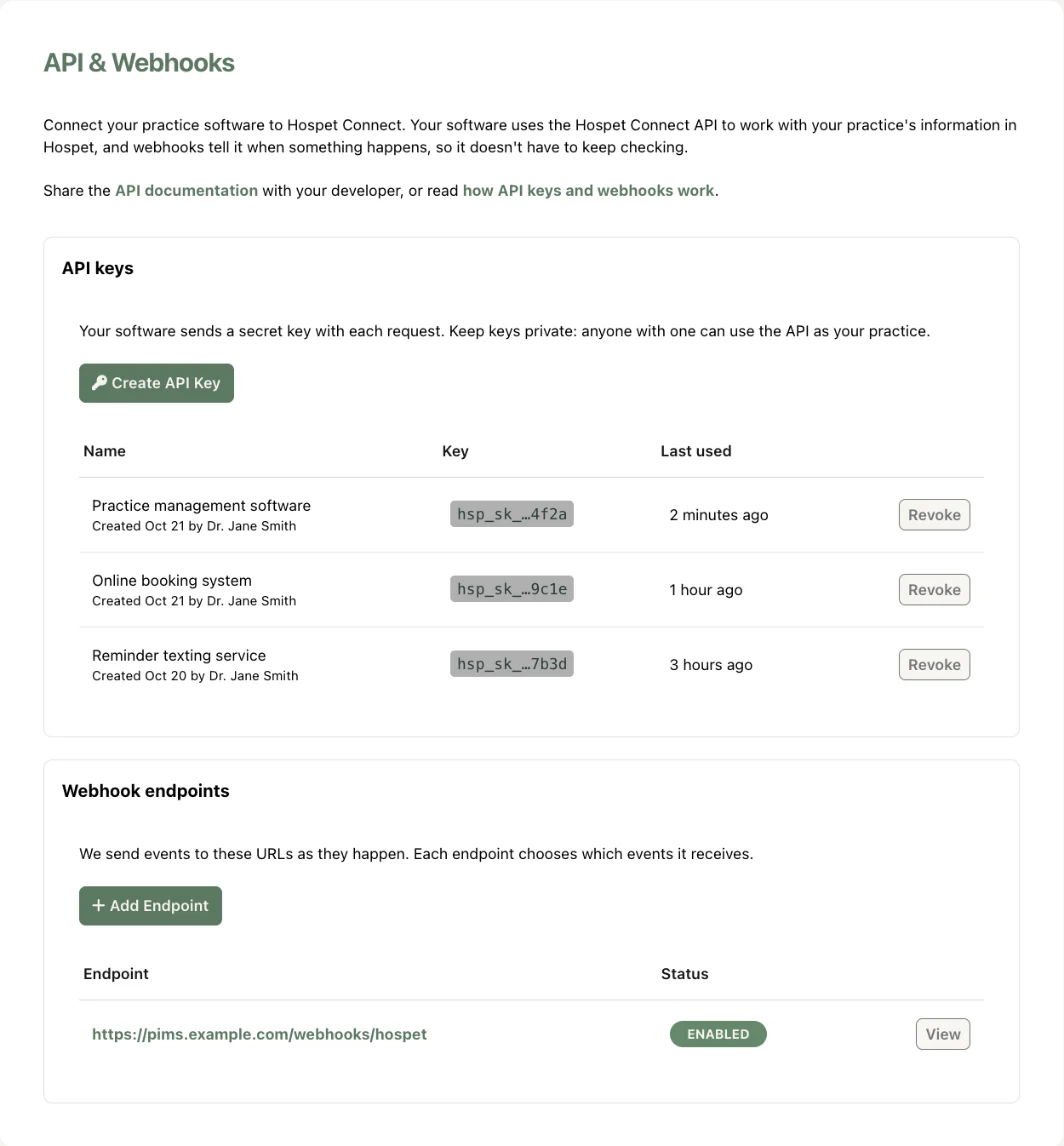
If you’d rather send assessments from your practice management software, your developer or software vendor can connect it using the Hospet Connect API. Your software can send an assessment from a patient’s record and receive the results and PDF automatically through webhooks, tagged with your own patient ID. Setup is covered in Using the Hospet Connect API and Webhooks.
When to Send an Assessment
- Before a recheck or palliative care consult, so you walk in knowing how the past week has gone
- After a change in medication or treatment, to see whether it’s helping
- At senior wellness visits, to record a baseline while the pet is doing well
- When a family asks how they’ll know whether their pet is comfortable
- Before an end-of-life consultation, so the family has had time to reflect at home
For guidance on introducing a scale to families, how often to reassess and how to read the results, see Using the HHHHHMM Quality of Life Scale in Veterinary Practice.
Try It With Your Next Client
Hospet Connect is free for veterinary practices, in-home euthanasia providers, specialty clinics and other care providers, and there’s nothing for your clients to install. See how Hospet works for veterinary teams, or create your free provider account.
Sources
- Belshaw Z, Asher L, Harvey ND, Dean RS. “Quality of life assessment in domestic dogs: An evidence-based rapid review.” The Veterinary Journal, 2015
- Bishop G, Cooney K, Cox S, et al. “2016 AAHA/IAAHPC End-of-Life Care Guidelines.” Journal of the American Animal Hospital Association, 2016
- Spitznagel MB, Jacobson DM, Cox MD, Carlson MD. “Caregiver burden in owners of a sick companion animal: a cross-sectional observational study.” Veterinary Record, 2017
Support your clients between visits with Hospet Connect
Hospet Connect is free for veterinary teams. Send your first quality of life assessment today.
Create Your Free Provider Account